Scull Shoals history
From a log fort to
four stories of brick.
Two hundred years of enterprise, fire and flood on the Oconee River: a frontier outpost, a paper mill, a cotton factory town, and then the quiet return of the forest.
- 10,000
- years of habitation
- 1784
- frontier land grants
- 1811
- first paper in Georgia
- 1887
- last great flood
Compiled by Friends of Scull Shoals from county records, newspapers and archaeological reports.
Begin the storyTen thousand years drawn to the shoals.
Native American hunter-gatherers were attracted to the fertile shoals for ten thousand years. What they left behind surfaces still: random pottery sherds and lithic projectile points turned up by ploughs, roots and archaeologists.
Around 900 A.D. the Mississippian period began, and corn agriculture came to dominate the entire Oconee Valley. Upstream from the mill complex, the Scull (Skull) Shoals mounds honoured powerful priests and chiefs. Mill workers later found skeletal remains there, which gave rise to the old spelling “Skull Shoals.”
The shoals remained a favourite hunting reserve for the Creek Nation, whose towns were centred along the Alabama and Georgia border, and whose visits were often friendly and often not.
A frontier held behind log forts.
Frontier settlement begins in 1784 with Revolutionary War veteran land grants along the Oconee and Apalachee rivers, a frontier boundary that held until 1802. Hard-scrabble cattle and tobacco farmers held off nature and Creek attacks.
In 1791 the aristocratic Virginian land baron Joel Early (1745–1806), father of Georgia governor Peter Early, bought 2,917 acres from the veteran Joseph Pannell, added 1,060 more, and named the whole plantation Fontenoy.
The Creeks declared war on white settlers after unjust land treaties of the 1780s and 90s. Greenesborough, barely a year old, was raided in 1787 with 31 casualties. In April 1793 a raid at Scull Shoals killed six people: a man, a woman, three children and one enslaved person.
Log forts, private and government, were urgently needed. In 1793 Lieutenant Cupp built Fort Clarke at Scull Shoals. Archaeologists are still looking for its traces.
In two years, 82 settlers in the middle Oconee valley were killed, and others maimed or captured.
Frontier Greene County, 1780s and 90s
Georgia’s first water-powered paper mill.
Eli Whitney’s cotton gin, invented in 1798, forever changed the South. Thousands of Scull Shoals acres went into cotton, planted and harvested by hundreds of enslaved people, then ginned and woven at the mill into a coarse Osnaburg, a muslin-like fabric.
In 1807 Thomas Ligon opened the first cotton ginnery in Greene County. By 1809 Ligon and Zachariah Sims were overseeing construction and operation of a gin, a grist mill, a lumber mill and a covered toll bridge as the county population grew to 12,000, largely agricultural and half Black.
Sims, a blacksmith and mechanical genius, sought a $4,000 loan over three years from the Georgia legislature as the War of 1812 loomed and high-seas embargoes cut off paper. He received $3,000 and advertised for rags to make paper.
Innkeepers George W. Paschal and Agnes Paschal, a self-taught nurse, accommodated mill visitors through the paper years. Drought, low water, a loan falling due and the end of the war defeated the enterprise. In 1815 Thomas Ligon took over after Sims’s bankruptcy and expanded textiles by re-purposing the existing buildings.
“The paper mill of Mr. Zachariah Sims, on the Oconee in Greene County, is now completed, and some sheets of paper for experiment have been made.”
Augusta Chronicle, 1811
The cotton empire of Dr. Poullain.
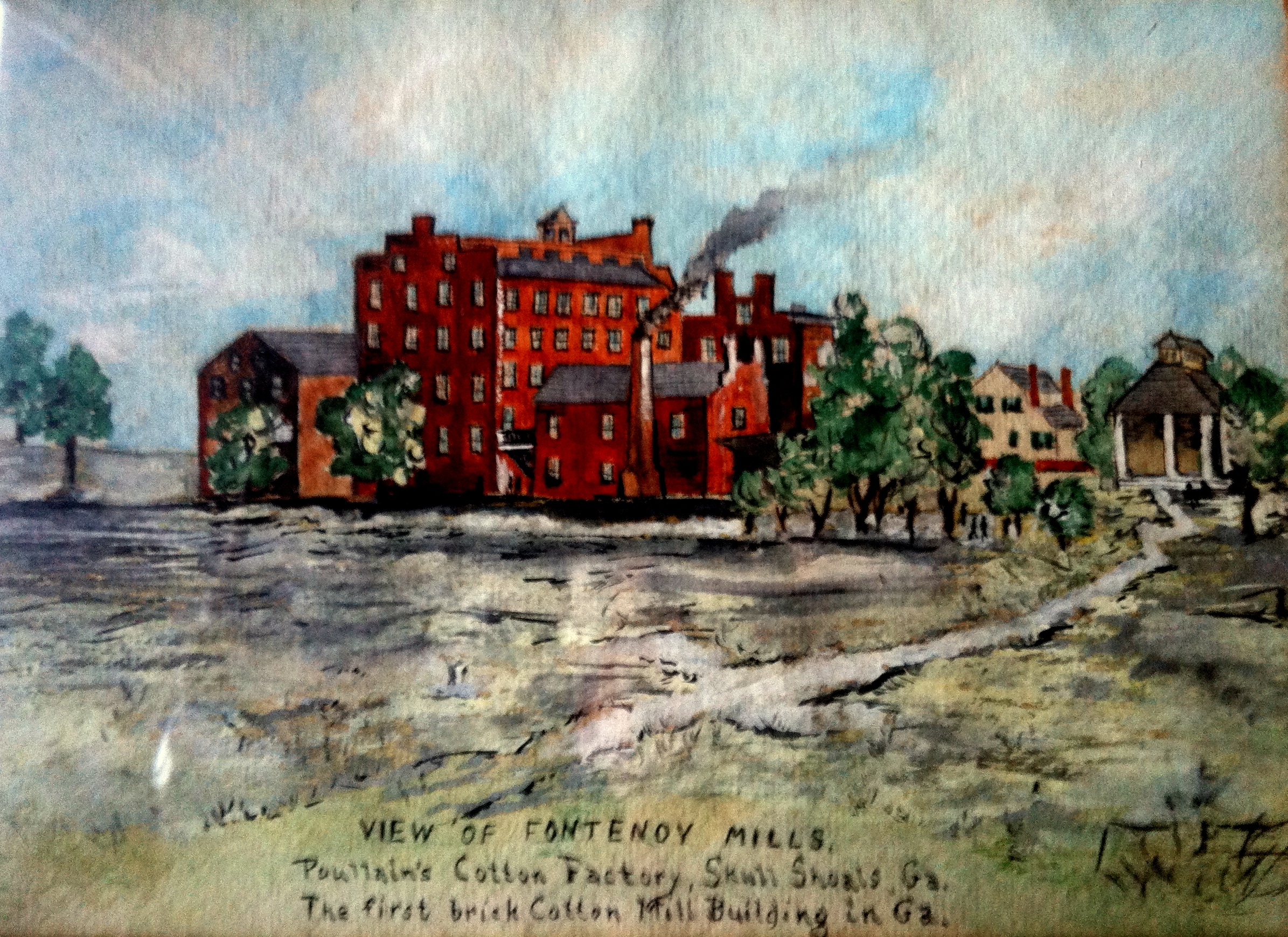
In 1827 Dr. Thomas Noel Poullain (1792–1889) bought the mills and 1,620 acres straddling the river, including Peter Early’s 348-acre estate, for $13,500. He moved to Scull Shoals, became postmaster, and was the largest slave owner in Greene County, with 145 people, largely raising cotton.
In 1832 Poullain, two Athens men and two Wray brothers-in-law put in $45,000 and incorporated the Skull Shoals Manufacturing Company. By 1835 the factory had grown to two large wooden frame structures, and the company advertised for 18 to 20 more operatives with “liberal wages and comfortable housing for families of five or more.” Children were welcome to contribute to production.
Federal tariffs against foreign goods and enormous cotton production breathed life into Georgia’s fledgling textile industry, and the Piedmont’s Oconee drainages offered prime water power. In 1830 local farmers harvested 12,000 bales, 4.8 million pounds, while the Scull Shoals mill consumed 4,000 bales a year and shipped Osnaburg through Augusta and Savannah.
Poullain, his sons and the Wray in-laws controlled the market from seed to sea: outside planters’ factoring, local planting and harvesting, processing, and warehousing at the coast.
- 2,000
- spindles at peak production
- 4,000
- bales of cotton consumed each year
Fire, freshet and the walls that still stand.
The mills coped with periodic natural and wartime events. Drought and low water crippled paper production in 1814. The Harrison Freshet of 1841, a major flood made worse by erosive cotton farming, washed the Oconee toll bridge a mile downstream; it was rebuilt.
On the night of 5 November 1845 fire destroyed the two largest buildings, a loss of $60,000 to $70,000, uninsured. Poullain hired workers to rebuild four stories tall in brick over two years, and those are the walls that still stand in the pines.
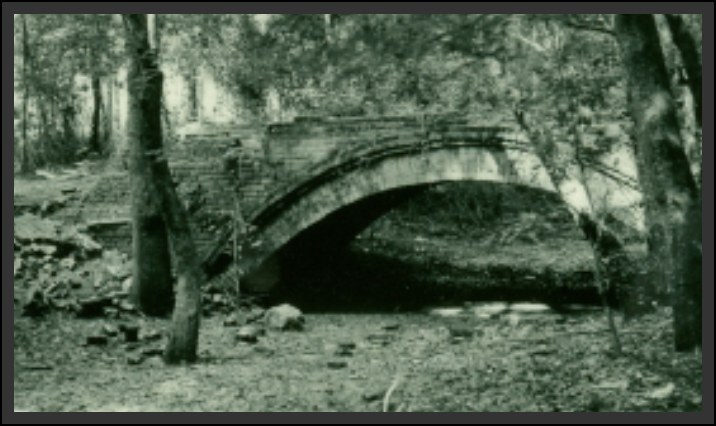
Silt from cleared fields kept raising the river. A new dam went in around 1850, and another was needed by 1860 after only ten years of intense farm runoff.
Then came the Civil War. The mill operatives, largely white, joined the Confederate cause and production halted; Madison was the closest action. Poullain, a diehard slave owner, voted for secession in Milledgeville.
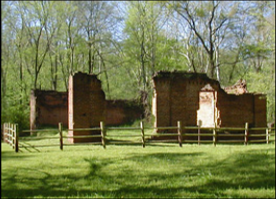
The voluminous lint and resinous heart pine quickly ignited, destroying the two largest buildings.
5 November 1845, about 9 p.m.
The forest moves back in.
The 1885–88 eruption of Krakatoa in the Pacific affected climate across 70 percent of the world, including Georgia, for several years. Dust made vivid sunsets, droughts and chaotic weather, and then the best crops ever.
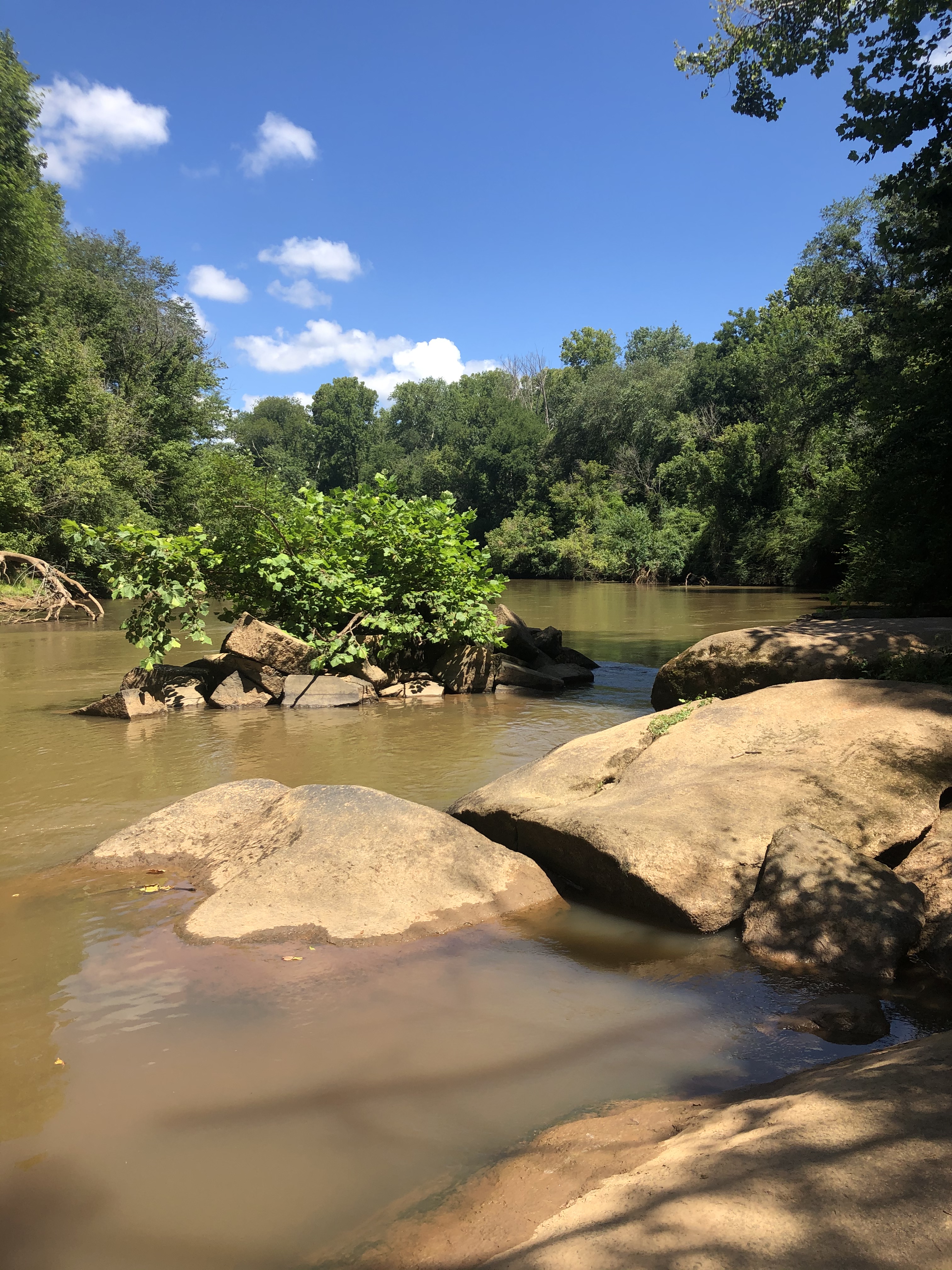
In 1887 a flood greater in volume and damage than the Harrison Freshet swept away the $8,000 bridge, which was never rebuilt. Its huge granite support column still stands mid-river. Six hundred bushels of warehouse wheat and several hundred cotton bales were ruined.
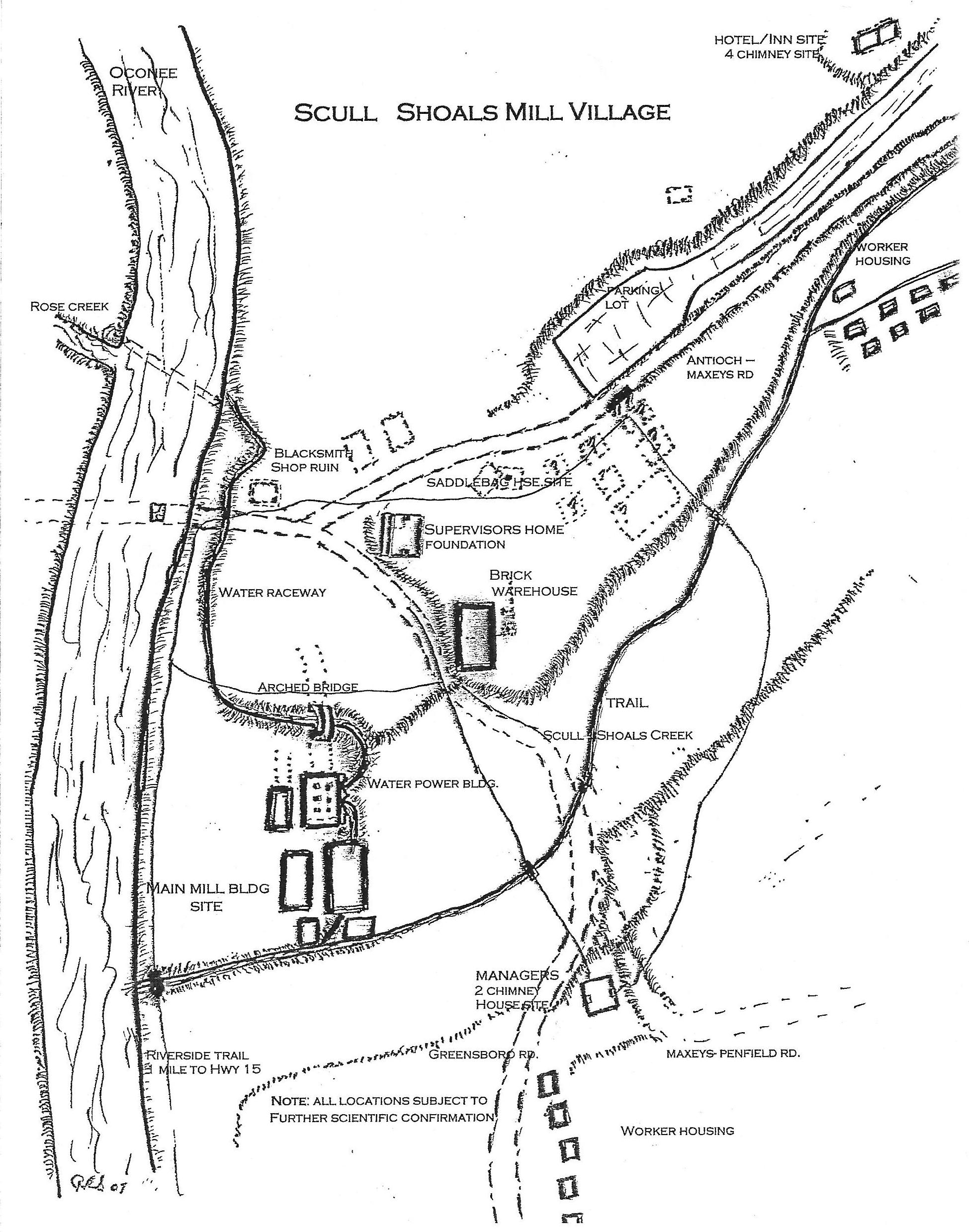
The mills fell silent. Families left, the Oconee National Forest reclaimed the streets, and the village became one of the most intact archaeological sites of its kind in the state.
Friends of Scull Shoals, a non-profit 501(c)(3) founded in 2000, works with Forest Service archaeologists and university researchers to keep the story, the brickwork and the walking trails open to anyone who stops to look.
What remains
Read the story, then walk the ground.
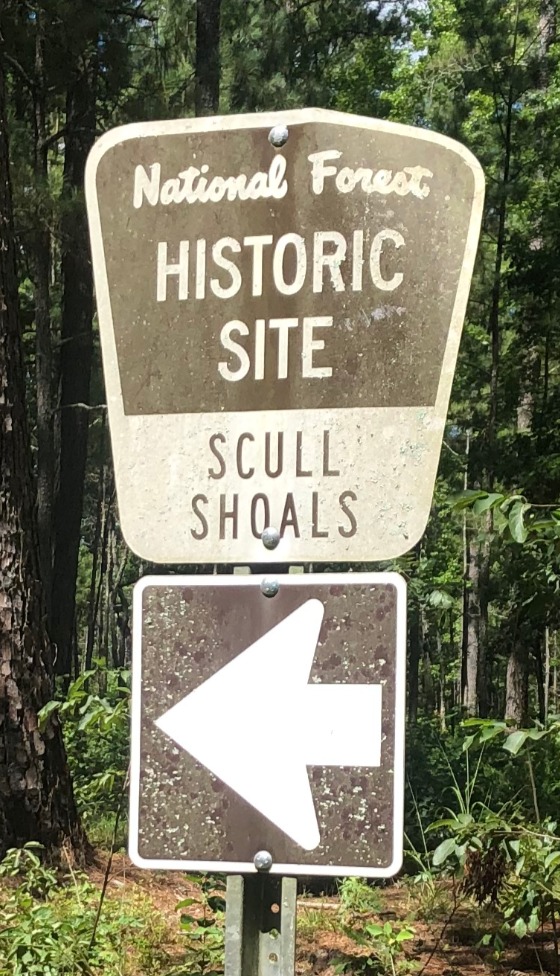
The brick walls, foundations and river shoals are a short walk from the parking area on Forest Service Road 1234. The site is free and open daily.
Next chapter
The people of Scull Shoals
Dig deeper
Archaeological research